Blogs
I almost killed Bob Moog
Tue, 05/07/2019 - 10:10 — AdrianFreed
- AdrianFreed's blog
- Login or register to post comments
- Read more
Leaving IRCAM in 1984
Sun, 05/05/2019 - 19:38 — AdrianFreedDuties: Computer Services Manager
Reason for leaving: Looking for a more research-oriented position
Adrian Freed is an extremely competent - and recognized - UNIX expert. Being always innovative and well organized, he was a very efficient group leader.
Adrian Freed was always available when needed, including off-hour moments (late at night or at weekends) when difficult tasks arose"
Jean-Pierre Keller"
The scientific director of IRCAM sent the above brief reference to Bell Labs, my employer after I was Responsable du Service Informatique at IRCAM. I found it in my archives while writing a CV. This reference is strikingly different to the implication about my departure from IRCAM reported (on page 254) in Georgina Born's pioneering book Rationalizing Culture where I am coded in the text as FA.
I have far more confidence in Georgina's recording of the events and in the various supporting documents than my own memory so it has been a fun puzzle to try to untangle from the record these different interpretations of my time at IRCAM. One thing emerges very quickly: Georgina's accuracy with respect to what she observed is impressive. She is a great ethnographer. A challenge was that she couldn't be at every meeting or interview everyone on an issue so any problems with her account are likely from errors of omission. She did go to meetings of the artistic committee where many grumbles about the availability of computing resources to complete pieces were voiced. She didn't attend scientific committee meetings so how these grumbles were discussed or responded to is not described very much in the book.
It might be interesting for someone to dig into the IRCAM archives and look at the minutes of those meetings. I will attest to their accuracy as I was responsible with Margaret Tunstill in writing them as secretary of that committee. This was something Pierre Boulez asked me to do because he liked my confident and responsible challenges to the 4X group who were overpromising and underdelivering. He had trouble finding an accepted or acceptable scientific director during this period to manage these issues so the committee was a rather clumsy apparatus to try to keep things honest. This pattern of overpromising and underdelivering was rather ubiquitous and obvious to me the first day on the job. I was hired to replace their PDP10 with a Vax 11/780 they had ordered. On arrival I reviewed the order and concluded their assumptions about what the Vax 11/780 and a new and unfamiliar and untested operating system UNIX BSD 4.1 could do were naive and optimistic. The system they ordered was configured so minimally it couldn't even run the operating system well - too little memory, too little I/O and inadequate disk space. I addressed this by creating a realistic budget, ordering the required extra parts and extending the operations of the PDP10 by the many months it took to bring the Vax 11/780 into operation so that pieces in process could finish their production.
Georgina does a good job of describing some of the resource contention issues at play in this period.
I will take these up in a future note because it is interesting that many of the core disagreements are still active in 2019.
It took a while for me to realize that the management structures in place were not going to produce the conditions where the Service Informatique could do its job well. One event that confirmed this for me and outlined my limited agency was when the programmer in my group, the late, great Patrick Sinz, told me he had been reassigned to the 4X group. This produced the need to bring the American consultants in to do the system software upgrades that Georgina refers to. I still don't know how that decision was made without consulting me but usually these sorts of things came about from private conversations with Pierre Boulez outside of the committees. It would have likely been Jean-Pierre Keller, David Wessel and Jean-Pierre Armand who brokered this particular compromise. This is an indication that points to the classical difference between what happens in practice and what diagrams like an organogram might suggest should happen.
The bar for how well a Service Informatique could run was set rather high for me by a mentor in college, Ian Johnstone, who hired me while I was a student into his group supporting computing for the Australian Graduate School of Management. Because of better funding and his generous hiring they had the best computing environment on the UNSW campus. Ian was an outstanding system's programmer and the PDP 11/70 he ran served an unusually large number of concurrent users with a very diverse range of software. I remember being disappointed with how poorly the Vax 11/780 at IRCAM ran compared to the supposedly inferior and much cheaper computer, the PDP 11/70. It actually took two major upgrades of BSD UNIX 4.3 before the Vax was really comparable. Many of Ian's performance innovations were integrated into those kernels. I mention this as it points to another omission in Georgina's account which emphasizes the reliance on US hardware and software. I was actually trained in Australia and many of the innovations introduced into IRCAM's software base can be traced there including the graphics package a college buddy installed. Also Patrick Sinz and the other french "squatters" were responsible for important software too - notably the integration of networking features as IRCAM pioneered participation in the emerging research internet and TRANSPAC.
I will close by outlining some facts about my departure:
My best π day
Thu, 03/14/2019 - 11:20 — AdrianFreed- AdrianFreed's blog
- Login or register to post comments
- Read more
555 Timer resources
Fri, 05/04/2018 - 16:35 — AdrianFreedHistory
There are few inaccurate histories of the 555 timer invention on the web so a good source is from the designer himself, e.g., http://semiconductormuseum.com/Transistors/LectureHall/Camenzind/Camenzi...He also wrote several interesting books. The history and detailed design considerations are covered in a book he kindly made available as a PDF file before his death in 2012: http://www.designinganalogchips.com/_count/designinganalogchips.pdf
Circuits
This is a reasonable compendium of interesting circuits using the IC: http://www.555-timer-circuits.comSome more:
http://www.nutsvolts.com/magazine/article/using-the-555-timer-ic-in-spec...
Radio Circuits
AM Receiverhttps://hackaday.com/2011/02/25/hear-that-its-a-555-timer-am-radio/
AM transmitter
http://www.circuitsgallery.com/2013/08/555-AM-transmitter-circuit.html
FM
http://streampowers.blogspot.com/2013/07/using-555-as-fm-transmitter-cir...
Audio Circuits
VCOHigh Performance VCO : http://www.electro-music.com/forum/topic-54623.html DRAWDIO
https://www.adafruit.com/product/124
ATARI PUNK CONSOLE http://www.synthrotek.com/products/lo-fi-synthesizer-circuits/atari-punk...
Variations
The CMOS versions of the 555 timer are interesting and lend themselves well to low voltage e-textile applications. My favorite variant is this one: https://www.jameco.com/z/CSS555-ID-Custom-Silicon-Solutions-CSS555-Micro...Here is the largest variant I know of: https://shop.evilmadscientist.com/productsmenu/tinykitlist/652-555kit
and the smallest (a 1mm x 1mm) package:
http://www.ti.com/product/LMC555/samplebuy https://www.mouser.com/Semiconductors/Integrated-Circuits-ICs/Clock-Time...
- AdrianFreed's blog
- Login or register to post comments
Circuit Layout Design Patterns for eTextiles Appliqués with Conductive Fabric
Sun, 04/22/2018 - 16:34 — AdrianFreedThis style is not convenient for eTextile Appliqués which are most commonly single-sided and are based on cut traces rather than etched boards.
There is an older style of PCB layout that is more suitable for low-speed e-textiles that I remember seeing with old transistor radios. The style is almost all copper with just a few lines etched away to separate conductors.
This makes designs more robust with multiple parts soldered on and removed and with multiple sewing points at the edges.
It also makes for less weeding and more surface area that will be fused/glued to the base fabric.

It was also common for many of the traces in these radios to be curved.
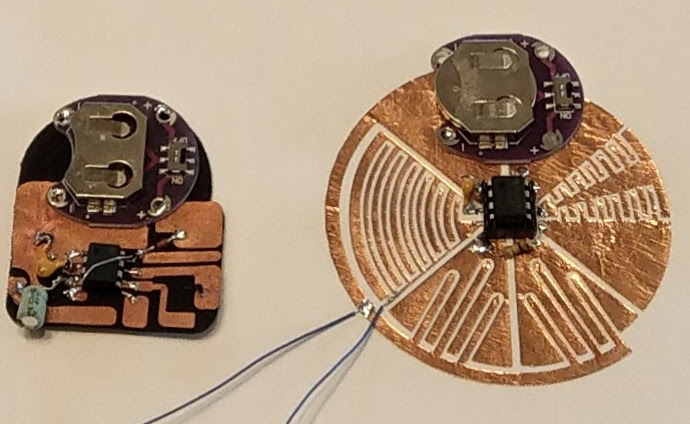
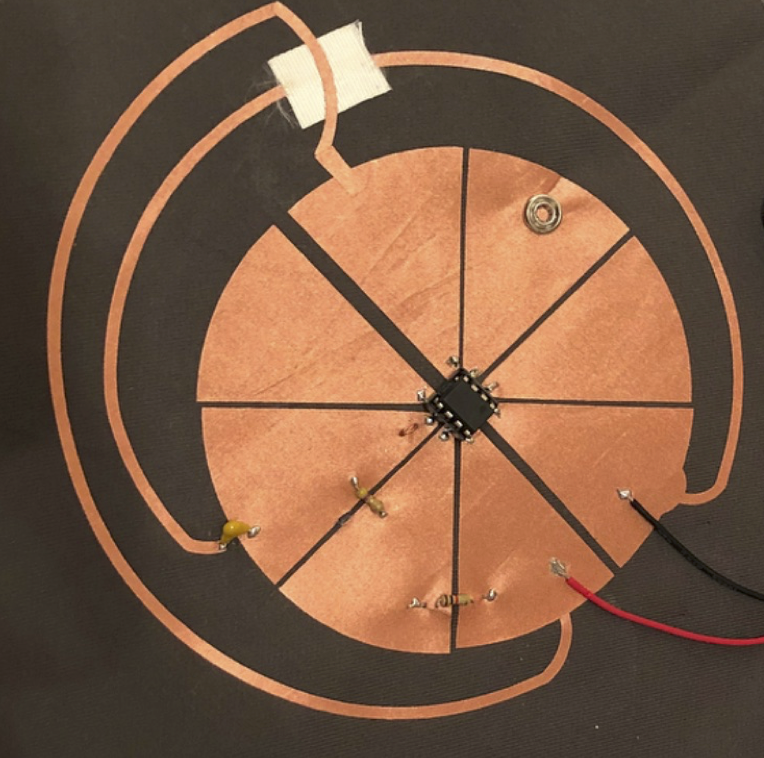
For the eTextile Spring Break I guided Martin De Bie through some iterations of his original Textilo design that includes this new thinking on layout and a further insight regarding the 8-pin DIP packages commonly used now by eTextile electronics experiments (with the ATTINY and 555 timer being common choices). This insight is to start the design from the DIP package and imagine the negative space of the smallest amount of conductive fabric that needs to be weeded to separate the 8 pins and combine the constraint of roughly equal area given to the conductors attached to each pin. This results in a motif with 8 radial lines and 8 triangles between them.
Here is the original textilo with its elegant pads to sew to:

Here is the next version with more conductive material to work with alongside the prototype of a radial design. The radial design includes serpentine interdigitation to allow for touch interaction:
Nicole Yi Messier picked up on this radial design pattern for her wearable 555 timer based FM radio transmitter:
- AdrianFreed's blog
- Login or register to post comments
Sound Making Technologies Ordered by Increasing Complexity/Cost/Size
Sun, 04/22/2018 - 15:36 — AdrianFreed| Approach | Example | Link |
|---|---|---|
| non-electronic | Lamello | http://bid.berkeley.edu/papers/chi/lamello_passive_acoustic_sensi/ |
| *Analog relaxation oscillator | Textilo | http://www.martindebie.com/research_project/textilo/ |
| Analog harmonic oscillator | self-resonating VCF | http://electronotes.netfirms.com/EN215.pdf |
| *Digital relaxation oscillator | Arduino Tone | https://github.com/adrianfreed/FastTouch |
| *Digital relaxation oscillator | Mozzi (LUT) | https://github.com/sensorium/Mozzi/blob/master/examples/01.Basics/Sinewa... |
| *Digital Modulation Synthesis | Mozzi (FM) | https://github.com/sensorium/Mozzi/tree/master/examples/06.Synthesis/FMs... |
| *Digital Subtractive Synthesis | Talkie (LPC Speech and singing) |
https://github.com/adrianfreed/Talkie |
| Unit Generator Library | Teensy Audio Library | https://www.pjrc.com/teensy/td_libs_Audio.html |
| Sampling "Synthesis" | Tone.js (Tone.Player) | https://tonejs.github.io |
| Dynamically Patched Unit Generators | Bela (libpd) | https://bela.io |
| Dynamically Patched Unit Generators with Image Synthesis |
Max/MSP/Jitter | https://cycling74.com/products/max |
| Analog Patched Modular | Modular | https://en.wikipedia.org/wiki/Modular_synthesizer |
- AdrianFreed's blog
- Login or register to post comments
FastTouch Open Source Arduino Library for Fast, Portable, Low Fidelity Capacitive Sensing
Sun, 04/22/2018 - 13:40 — AdrianFreedThe example code provided with the library uses the Arduino Tone library to sound pitches according to which pins are touched.
Notice that each call to the fast touch library implements a cycle of a relaxation oscillator.
I am indebted to Alice Giordani for exemplifying use of the library so well in this dreamcatcher:
- AdrianFreed's blog
- Login or register to post comments
A Self Organizing Classification System by BLW Chapman
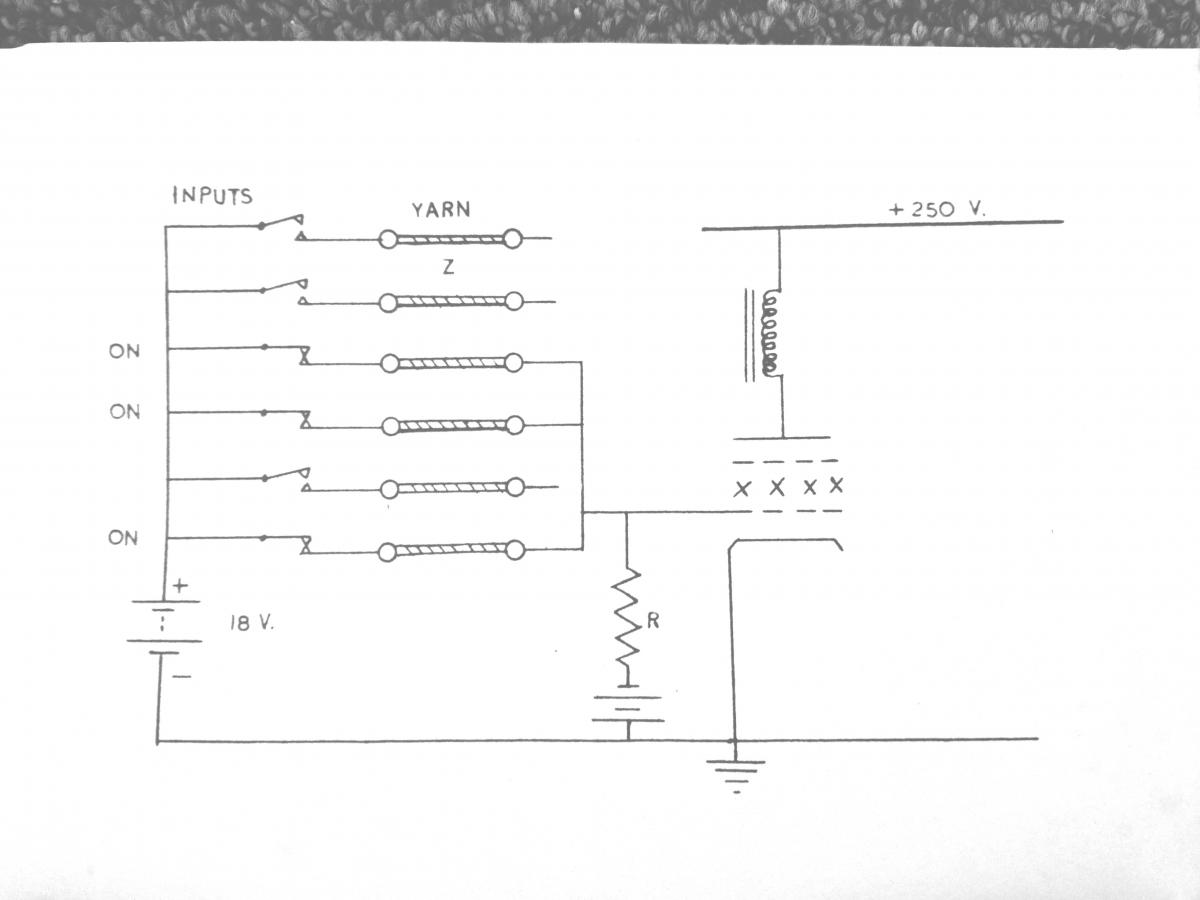
Mon, 04/16/2018 - 16:40 — AdrianFreed"I have recently completed building an electronic model of the 'growth net' principle and will now give a brief outline of its method of operation."
"What I described earlier as a common boundary now takes of the form of a moist fibre of cotton yarn connecting each input to the control grid of a pentode"
"The use of moist cotton fibre for storage has considerably reduced the size of the machine from the original plan which was to use condenser storage. By application of a hygroscopic agent such glycerin to the fibre the memory time of the machine can be controlled".
- AdrianFreed's blog
- Login or register to post comments
Introduction to Relaxation Oscillators
Wed, 04/11/2018 - 17:20 — AdrianFreed- AdrianFreed's blog
- Login or register to post comments
Caña Dulce and Caña Brava in San Francisco
Sat, 02/03/2018 - 15:00 — AdrianFreed
The Son Jarocho tradition is more than a musical genre, or a repertoire of traditional songs or a set of playing techniques or a local cultural practice or a dance and festival music or a set of instrumental performance techniques. It is all those things and it may also be unique in mexican music in having a robust practice for social transmission. It has influenced and fermented other musics and it has found its way to new audiences via film, popular recordings, and under the rubric of a world music in the notable, influential recordings in Paris of the revered harpist La Negra Graciana.
In their teaching workshops the members of Caña Dulce and Caña Brava employ many useful ways to overcome the conundrums and challenges of teaching a traditional music to curious, motivated outsiders. Perhaps the core conundrum is that the singing, music and dance is natural and “simple” in it’s fully integrated form experienced in a fandango or in the social familial contexts where it is learned by young children in the seamless flow of growing up. Without this context learning each skill (privately or with a single teacher) is strangely disorienting. The solution as you might guess is that the group brought the many aspects of the tradition together in each class. For example the whole group was present in the opening zapateado dance class of Violeta Romero’s. Rather than take the group through an entire set sequence for a particular Son (many of the Sones have established theatrical scenarios), she opted to teach core steps which together symbolize for me a strongly resonant value in this tradition: inclusiveness. These steps covered standing in one place, traveling and turning at both a high and low energy and also a nearly completely quiet step. This range of steps is essential to allow the turn taking so important to this tradition where the focus can shift between vocalists, to dancer, and musician with ample room for the full range between quiet, unassuming ordinary expressiveness to highly skilled moments of instrumental virtuosity. Each of these elements can be found in other traditions, the importance of improvisation to jazz for example, but I enjoy the inclusiveness of all the elements as Caña Dulce and Caña Brava exemplifies.
In the Jarana workshops, Raquel Palacios Vega seamlessly adapted the strums and chord choices to the skills of the participants making sure the large groups in each case were kept actively playing with a reachable challenge. Anna Sylvia Arisméndez spotted moments of struggle and gave quick individual micro-lessons to keep people on the train.
One of the question periods stands out in my mind when Alejandro Loredo improvised a response by playing interesting pairings of Sones illustrating contrasting metrical aspects in the rhythmic cells that are the kernel of each Son. This is another powerful approach that helps outsiders to get inside playing the music. It’s a complementary scaffolding to the one Raquel Palacios Vega provided as she build up variations from the core strums. Alejandro Loredo’s continued this scaffolding in the Rhythm workshop illustrating core “clave” rhythms notationally, vocally and instrumentally.
In that question session from the Jarana workshop, the group explained how the group started. A follow-up question from a participant asked who was sweet (Dulce) and who was stout/strong (Brava). The groups response took the question in good humor but I found something frustratingly divisive at the heart of the question. It invokes disagreement and whether the group addresses them adversarially or harmoniously. I wanted to respond strongly and assure the questioner that ALL the members of the group are earnestly working life’s challenge of being sweet and strong, open and boundaried. Such a response from me would not have been kind or “sweet” because I could not know how the questioner might be suffering in their work or home life from asymmetric power and the insecurities it produces.
There is something glorious in the inclusiveness and openness of the Son Jarocho tradition which makes room for life’s challenges to be both experienced and melted away in the joy of a deeply participatory experience so beautifully animated by Caña Dulce and Caña Brava.
Adrian Freed. Feb 3 2018
p.s. Here follows my translation of exerpts of a 2015 article that has some of the issues I bring up expressed in the artists own words.
“Caña Dulce and Caña Brava breaks molds with feminine prowess”
Juan José Olivares http://www.jornada.unam.mx/2015/03/07/espectaculos/a08n1esp (translation Adrian Freed)
"This is a rural music in which machismo is deeply rooted. In the city there is an influence of new ideas on aspects of the tradition. But I've had to hear anecdotes from well-known people in our community who jokingly (by the way) make comments such as: 'What do you think? Are you a woman?'
“We fall into those ridiculous games about being masculin and we miss the diversity of expression” , comments Alejandro Loredo, who plays the guitar in the group Caña Dulce and Caña Brava, which highlights a female sensibility in the music, singing and the lyrics in Son Jarocho a genre historically played by men. Caña Dulce and Caña Brava are: Adriana Cao Romero Alcalá, harp and voice; Raquel Palacios Vega, jarana and voice; Violeta A. Romero Granados, jarana, voice and zapateado, and Alejandro Loredo.
"Almost all the lyrics in son jarocho are very masculine in perspective. It is a man who sings to the woman. "Almost always in fandangos we talk about things about them ... There we are singing to women, as if to love them. Well now our proposal is consistent with that perspective in the lyrics. We try to provide verses for women. Also in the sound you can hear a difference: we play a little softer, with another intensity, "says Violeta Romero.
Caña Dulce and Caña Brava, established in 2008, “adds to that national revelry that means, throughout Mexico at the beginning of the century, the cultural phenomenon of the rebirth of traditional music” , said the Cuban writer, poet and bomber, Alexis Diaz-Pepper. The combo has new material: Sones jarochos. Thus, a name without major complication or pretension. A basis in which you do not want to rescue the son, but to approach it and dance it with “legitimate naturalness” .
“Between games and play, from childhood we have learned the sones. The traditional melodies are reflected in our album. We do not have exceptional arrangements, but we do the music from the heart and I think it shows” , says Raquel, who comes from two of the most revered traditional families: Los Vega and Los Palacios. Raquel, a wellspring of this tradition, says that there is a great difference in terms of acoustics between the masculine and feminine in the son. “It is revealed for example in the intensity of the jaranas, that somehow have a different language. She also participated with the Los Vega group, in which the majority are men; they have a different way of playing the instrument and singing. There is a difference, simply because women have their own language and that does not mean that we have something against them, or a rivalry, much less, but we make softer sounds and the lyrics are different.”
The man of the group, reveals that since he was 10 he played music, and has always had an inclination towards unusual sounds. “To those from old people: the old ones, whose way of playing is very similar to that of women in terms of work: they do not walk so hard, they give their space to the notes, they open them to the nuances that, young nen, in the waste of energy, forget.”
Alejandro says that “this project of women who have shown that they deserve a place in the community of soneros through their work is wonderful. The CD is a consolidation of these ideas and work”.
- AdrianFreed's blog
- Login or register to post comments