Exemplary
The Paper FingerPhone, a sustainably designed electronic Musical Instrument
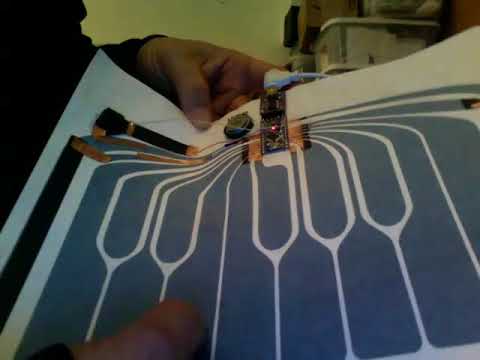
Fri, 01/26/2018 - 16:00 — AdrianFreedThe next version used a pizza box as the resonator to demonstrate reuse as the sustainability aspect was emphasized..
Eventually it was placed on cardboard to be attached to poster board where it won "Best Poster" award at the NIME conference.
The conference paper associated with that poster presentation was chosen for inclusion in the NIME reader.
Notations for Performative Electronics: the case of the CMOS Varactor
Mon, 03/08/2021 - 15:18 — AdrianFreed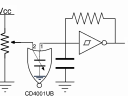
Summary
Demonstrating an unusual application of a CMOS NOR gate to implement a CMOS varactor controlled VCO, I explore the idea of circuit schematics as a music notation and how scholars and practitioners might create and analyze notations as part of the rich web of interactions that constitute current music practice.
A Synthesizable Hybrid VCO using SkyWater 130nm Standard-Cell Multiplexers
Sat, 03/06/2021 - 23:03 — AdrianFreed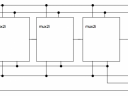
Summary
I introduce a new synthesizable VCO using (n+1) mux2i cells from the SkyWater130 PDK to form a (2n+1) hybrid ring oscillator.C++ container output stream header file
Thu, 09/24/2020 - 17:30 — AdrianFreedMachine Learning and AI at CNMAT
Fri, 07/24/2020 - 15:27 — AdrianFreedCelebrating Valérie Lamontagne
Wed, 10/09/2019 - 13:47 — AdrianFreed
Last week the world of wearables lost the light of one our shining stars, Valérie Lamontagne.
I invite you to celebrate her life by reading, citing and responding in your own way to one of her major life’s works: her 2017 dissertation: “Performative Wearables: Bodies, Fashion, and Technology”.
You can find it here: https://spectrum.library.concordia.ca/982473/
She covers some examples used in her dissertation here: https://vimeo.com/196041125
Valérie’s dissertation contributes to the field of wearables by carefully and clearly looking at our field with a combination of two powerful lenses: performativity and non-human agency. Performativity is a well-established lens articulated by Austin for speech acts, made popular by its use for gender by Judith Butler, for power by Jean-François Lyotard, and Karen Barad for cultural and feminist studies of science. Explorations of non-human agency have taken on a recent urgency from the extinction and climate crises. Both these lenses have a long, interesting, convoluted intellectual history so I especially appreciate Valérie’s approach of using extensive case studies of applications familiar to us as a “soft” way into learning the conceptual underpinnings.
What might you be able to do with the deeper understanding that comes from reading this work? It can give you a grasp on the thorny problem of cultural uptake- which designs will have lasting impact? Why do we see the same designs (tropes) being recycled in the field, e.g., cellphone/music player controlling backpacks? It can deepen understanding and appreciation of recent exploratory work in the field. For example, Hannah Perner-Wilson, has been exploring and celebrating the humble pin. She has moved from from pin as a tool, to pin as a material and in her recent whimsical work to pin as an active agent with its own agendas.
I was using performativity, non-human agency and related lenses in my studies of the history of electronic musical instruments while I was in the same program as Valérie at Concordia (INDI). As I surveyed images of the labs. where these musical instruments were created in the last 100 years, I saw one piece of apparatus “photobombing” every picture: the oscilloscope. I no longer see this as a prop or minor tool of the trade. As a non-neutral visualizer of certain sounds it has huge agency over what these electronic musical instruments did. It delayed the adoption of “noisy” and “chaotic” sounds because they don’t visualize well on the traditional oscilloscope. And so it is with the battery of wearable technology. The battery’s promise to deliver power is underwritten by our promise to recharge them. This agency of entrainment has induced “range anxiety” ever since the wearables of the nineteenth century to modern electric vehicles.
As Melissa Coleman and Troy Nachtigall just pointed out, Valérie Lamontagne, did not have a chance to expand and broadly diffuse the fruits of her Ph. D. labor. Dissertation work can easily get lost in libraries and obscure university web sites because it isn’t indexed as well as conference/journal/book publications. It has only 4 citations in scholar.google.com as I write this.
Even as we struggle with our shock and sorrow, let’s read and share her deep and valuable work.
CMOS Inverter Oscillator
Wed, 05/08/2019 - 09:36 — AdrianFreed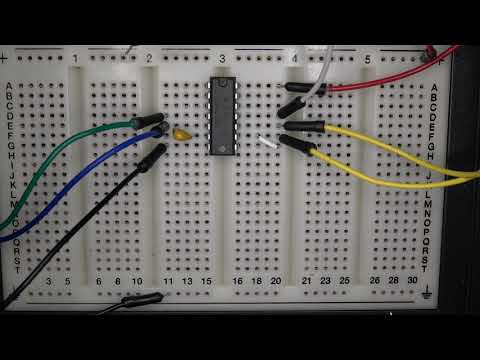
Analog and Digital Sound Synthesis as Relaxation Oscillators
Thu, 04/11/2019 - 17:40 — AdrianFreedThe following pages provide context for the workshop and include links to contributions from my co-teacher, Martin De Bie. This includes pointers to various iterations of his 555 timer-based Textilo project.
This project will be expanded ongoingly with further relaxation oscillator schemes.
My best π day
Thu, 03/14/2019 - 11:20 — AdrianFreedCircuit Layout Design Patterns for eTextiles Appliqués with Conductive Fabric
Sun, 04/22/2018 - 16:34 — AdrianFreedThis style is not convenient for eTextile Appliqués which are most commonly single-sided and are based on cut traces rather than etched boards.
There is an older style of PCB layout that is more suitable for low-speed e-textiles that I remember seeing with old transistor radios. The style is almost all copper with just a few lines etched away to separate conductors.
This makes designs more robust with multiple parts soldered on and removed and with multiple sewing points at the edges.
It also makes for less weeding and more surface area that will be fused/glued to the base fabric.

It was also common for many of the traces in these radios to be curved.
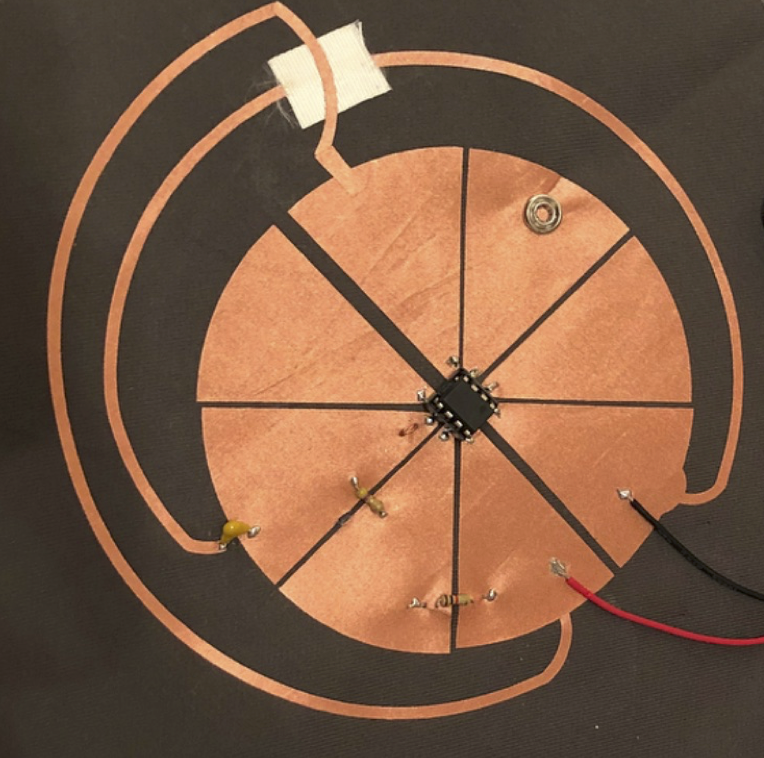
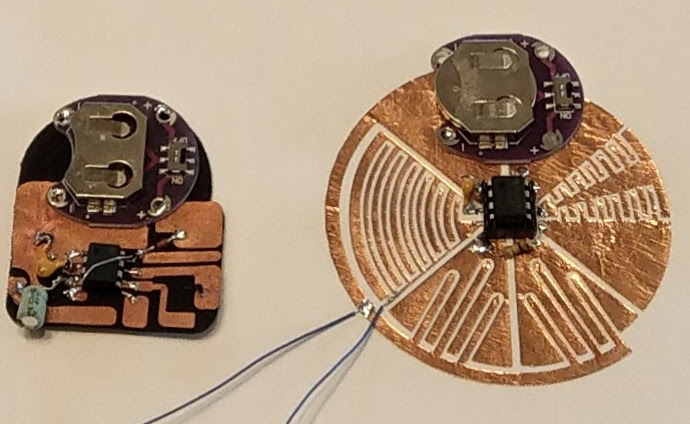
For the eTextile Spring Break I guided Martin De Bie through some iterations of his original Textilo design that includes this new thinking on layout and a further insight regarding the 8-pin DIP packages commonly used now by eTextile electronics experiments (with the ATTINY and 555 timer being common choices). This insight is to start the design from the DIP package and imagine the negative space of the smallest amount of conductive fabric that needs to be weeded to separate the 8 pins and combine the constraint of roughly equal area given to the conductors attached to each pin. This results in a motif with 8 radial lines and 8 triangles between them.
Here is the original textilo with its elegant pads to sew to:
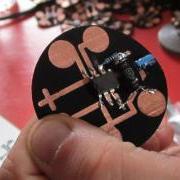
Here is the next version with more conductive material to work with alongside the prototype of a radial design. The radial design includes serpentine interdigitation to allow for touch interaction:
Nicole Yi Messier picked up on this radial design pattern for her wearable 555 timer based FM radio transmitter: