This annotated version by Adrian Freed borrows some ideas from medieval glosses. It is intented to provide context and readability unavailable in the original pdf.
Influential
The Paper FingerPhone, a sustainably designed electronic Musical Instrument
Fri, 01/26/2018 - 16:00 — AdrianFreed
The first paper FingerPhone was created to demonstrate conductive paper at the East Bay Maker Faire.
It was built using the speaker in a large musical greeting card that Hallmark used to make with a bending mode transducer.
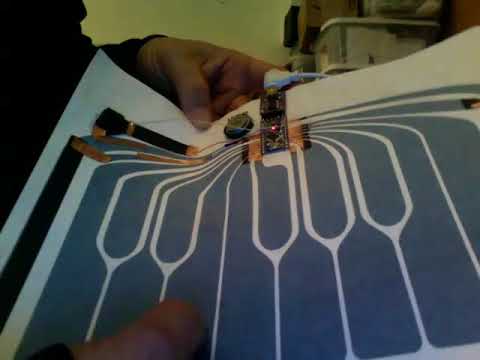
The next version used a pizza box as the resonator to demonstrate reuse as the sustainability aspect was emphasized..
Eventually it was placed on cardboard to be attached to poster board where it won "Best Poster" award at the NIME conference.
The conference paper associated with that poster presentation was chosen for inclusion in the NIME reader.
Managing Complexity with Explicit Mapping of Gestures to Sound Control with OSC
Fri, 03/12/2021 - 14:32 — AdrianFreedManaging Complexity
with Explicit Mapping of Gestures to Sound Control
with OSC
Matthew Wright
Adrian Freed
Ahm Lee
Tim Madden
Ali Momeni
email: {matt,adrian,ahm,tjmadden,ali}@cnmat.berkeley.edu
UC Berkeley
1750 Arch St.
Berkeley, CA 94709, USA
Machine Learning and AI at CNMAT
Fri, 07/24/2020 - 15:27 — AdrianFreed
This is the first of a set of thematic overviews of CNMATs work I am writing that
cover the period since our inception to the closing
in 2017 of the research sector after David Wessel’s death. The activities themselves
are more completely understood with concurrent perspectives of many themes so this serialization
is more a reflection of the cursed sequentiality of language than any suggestion that a particular theme
might be more important than an other. Future themes may include Spatial Audio, Musical Programming Tools,
Musical control Structuring, Instrument Building, etc.
Celebrating Valérie Lamontagne
Wed, 10/09/2019 - 13:47 — AdrianFreed
Last week the world of wearables lost the light of one our shining stars, Valérie Lamontagne.
I invite you to celebrate her life by reading, citing and responding in your own way to one of her major life’s works: her 2017 dissertation: “Performative Wearables: Bodies, Fashion, and Technology”.
You can find it here: https://spectrum.library.concordia.ca/982473/
She covers some examples used in her dissertation here: https://vimeo.com/196041125
A Self Organizing Classification System by BLW Chapman
Mon, 04/16/2018 - 16:40 — AdrianFreed
I learned about this work as a teenager and managed to trace my fuzzy recollection while researching connections between textiles and electronics. It was published in Cybernetica Volume 2.
"I have recently completed building an electronic model of the 'growth net' principle and will now give a brief outline of its method of operation."
"What I described earlier as a common boundary now takes of the form of a moist fibre of cotton yarn connecting each input to the control grid of a pentode"
The Paper FingerPhone: a case study of Musical Instrument Redesign for Sustainability
Mon, 01/15/2018 - 15:38 — AdrianFreedCommentary proposed for NIME Reader
The fingerphone is my creative response to three umbridges: the waste and unsustainability of musical instrument manufacturing practices, the prevailing absence of long historical research to underwrite claims of newness in NIME community projects, and the timbral poverty of the singular, strident sawtooth wavefrom of the Stylophone – the point of departure for the fingerphone instrument design.
David Wessel’s Slabs: a case study in Preventative Digital Musical Instrument Conservation
Mon, 01/15/2018 - 15:38 — AdrianFreed
David Wessel’s Slabs: a case study in Preventative Digital Musical Instrument Conservation,
, SMC2016, 2016, Hamburg, (2016)
Where there is a Whug there is a Way: Triaxial e-textile Breadboard
Sun, 07/16/2017 - 01:16 — AdrianFreedDescription:
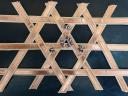
Rectangular grids are dominant forms in electronics and textiles. Triaxial grids have not been explored in e-textile work so this breadboard is offered to begin these explorations. Triaxial grids sample the plane with higher density and the availability of whug connections as well as warp and woof simplifies circuits by providing a natural power/ground/signal triple.
e-textile Interactive Demonstration at Maker Faire 2007
Sat, 06/02/2007 - 12:32 — AdrianFreed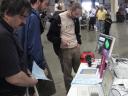
In 2016 I made the video below of a tear-down of those e-textiles with Hannah Perner Wilson.
Our Maker Faire table also include some great interactive demos whipped together by Andy Schmeder.
Michael Zbyszynski dropped in and talked about his Ikea bowl speakers.
It was great that Dan Overholt was nearby demonstrating his e-field sensor array.