textile
Celebrating Valérie Lamontagne
Wed, 10/09/2019 - 13:47 — AdrianFreed
Last week the world of wearables lost the light of one our shining stars, Valérie Lamontagne.
I invite you to celebrate her life by reading, citing and responding in your own way to one of her major life’s works: her 2017 dissertation: “Performative Wearables: Bodies, Fashion, and Technology”.
You can find it here: https://spectrum.library.concordia.ca/982473/
She covers some examples used in her dissertation here: https://vimeo.com/196041125
Circuit Layout Design Patterns for eTextiles Appliqués with Conductive Fabric
Sun, 04/22/2018 - 16:34 — AdrianFreedThis style is not convenient for eTextile Appliqués which are most commonly single-sided and are based on cut traces rather than etched boards.
Sound Making Technologies Ordered by Increasing Complexity/Cost/Size
Sun, 04/22/2018 - 15:36 — AdrianFreedIntroduction to Relaxation Oscillators
Wed, 04/11/2018 - 17:20 — AdrianFreedWhere there is a Whug there is a Way: Triaxial e-textile Breadboard
Sun, 07/16/2017 - 01:16 — AdrianFreedDescription:
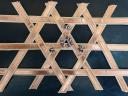
Rectangular grids are dominant forms in electronics and textiles. Triaxial grids have not been explored in e-textile work so this breadboard is offered to begin these explorations. Triaxial grids sample the plane with higher density and the availability of whug connections as well as warp and woof simplifies circuits by providing a natural power/ground/signal triple.