e-Textile Musical Instruments
Circuit Layout Design Patterns for eTextiles Appliqués with Conductive Fabric
Sun, 04/22/2018 - 16:34 — AdrianFreed
In the usual approach to PCB layout traces are laid out to connect signals and power to the pads of packaged parts and I/O connectors. This is a style that evolved for very high speed digital circuits. One usually also employs ground and/or power planes or a ground flood.
This style is not convenient for eTextile Appliqués which are most commonly single-sided and are based on cut traces rather than etched boards.
FastTouch Open Source Arduino Library for Fast, Portable, Low Fidelity Capacitive Sensing
Sun, 04/22/2018 - 13:40 — AdrianFreed
The fast touch algorithm reimplemented in the library available here was developed for my FingerPhone Instrument.
The fast touch library senses touch on any digital I/O pin on many embedded controllers with the Arduino IDE. This includes Atmega 8-bit, SAMD21, and Teensy. This includes most pins on most micro-controllers. A few micro controllers have analog input pins that can't also do digital I/O .
The library relies on the ability to enable a built-in pull-up resistor on the pin being sensed.
Here is the algorithm:
set the pin to output a LOW value for 1uS or so.
Introduction to Relaxation Oscillators
Wed, 04/11/2018 - 17:20 — AdrianFreed
Here is a non-electronic relaxation oscillator:
Augmented Electric Guitar
Sat, 12/12/2009 - 20:08 — AdrianFreed
e-textile Interactive Demonstration at Maker Faire 2007
Sat, 06/02/2007 - 12:32 — AdrianFreed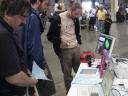
In 2016 I made the video below of a tear-down of those e-textiles with Hannah Perner Wilson.
Our Maker Faire table also include some great interactive demos whipped together by Andy Schmeder.
Michael Zbyszynski dropped in and talked about his Ikea bowl speakers.
It was great that Dan Overholt was nearby demonstrating his e-field sensor array.