Notebook
555 Timer resources
Fri, 05/04/2018 - 16:35 — AdrianFreedHistory
There are few inaccurate histories of the 555 timer invention on the web so a good source is from the designer himself, e.g., http://semiconductormuseum.com/Transistors/LectureHall/Camenzind/Camenzi...He also wrote several interesting books. The history and detailed design considerations are covered in a book he kindly made available as a PDF file before his death in 2012: http://www.designinganalogchips.com/_count/designinganalogchips.pdf
Circuits
This is a reasonable compendium of interesting circuits using the IC: http://www.555-timer-circuits.comCircuit Layout Design Patterns for eTextiles Appliqués with Conductive Fabric
Sun, 04/22/2018 - 16:34 — AdrianFreedThis style is not convenient for eTextile Appliqués which are most commonly single-sided and are based on cut traces rather than etched boards.
Sound Making Technologies Ordered by Increasing Complexity/Cost/Size
Sun, 04/22/2018 - 15:36 — AdrianFreedFastTouch Open Source Arduino Library for Fast, Portable, Low Fidelity Capacitive Sensing
Sun, 04/22/2018 - 13:40 — AdrianFreedA Self Organizing Classification System by BLW Chapman
Mon, 04/16/2018 - 16:40 — AdrianFreed"I have recently completed building an electronic model of the 'growth net' principle and will now give a brief outline of its method of operation."
"What I described earlier as a common boundary now takes of the form of a moist fibre of cotton yarn connecting each input to the control grid of a pentode"
Introduction to Relaxation Oscillators
Wed, 04/11/2018 - 17:20 — AdrianFreedPublications (Bibliography) Workflow 2018
Mon, 01/29/2018 - 15:04 — AdrianFreedFirst Paper Fingerphone Prototype
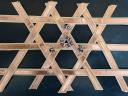
Mon, 01/15/2018 - 16:18 — AdrianFreedWhere there is a Whug there is a Way: Triaxial e-textile Breadboard
Sun, 07/16/2017 - 01:16 — AdrianFreedDescription:
Rectangular grids are dominant forms in electronics and textiles. Triaxial grids have not been explored in e-textile work so this breadboard is offered to begin these explorations. Triaxial grids sample the plane with higher density and the availability of whug connections as well as warp and woof simplifies circuits by providing a natural power/ground/signal triple.
Favorite eTextile Materials
Tue, 05/01/2012 - 14:54 — AdrianFreedI like to build intrinsic sensors with fabric because they are more flexible and survive washing and environmental stresses better than extrinsic modules such as those in the Lilypad ecosystem.