Exploratorium 2010

Devices, instruments and techniques shown at the Exploratorium in San Francisco in 2010, in the month-long exhibit Interactive Wearables, Soft Circuit Light Sculptures and Musical Instruments and its demonstrations: the posts tagged Exploratorium Exhibit 2010 or Exploratorium Demo 2010.

Experimental, Portable eTextile Electronics Lab 2010

Now that I have assembled one of the largest collection of e-textile materials and associated tools I am trying to figure out the smallest winning subset that can form a portable lab.

eTextile Pressure Sensing Touch Pad

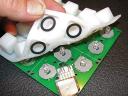
These are built by sandwiching a piece of porous, spacing fabric (e.g. tulle) between two sheets of piezoresistive fabrics (from Eeonyx). For the square pad depicted below rectangular sheets are placed at right angles and wrap around the frame. On the inside they are stapled to a conductive strip on each edge. The four edges are wired to the analog inputs of a suitable microcontroller, e.g.

Two Way Fabric Leaf Switch

This is assembled using hot melt adhesive backed conductive copper fabric.

Pressure Sensing Ball using eeontex Resistive spandex

A hard ball is surrounded by crumpled resistive fabric (nylon and spande)x and trapped by a round ball of silicone with holes in it. Sensing in various orientations is achieved by wrapping conductors between the holes of the silicon ball.

Fabric Slide Potentiometer

A loop of conductive thread is sewn on either side of the base fabric under the flaps. An inverted toggle from a clasp for jeans is used to short each conductor lowering the resistance of the loop.

etextile Leaf Switch with Iron-on hot melt adhesive

Iron on a small strip of the copper fabric to a non-conductive base. Cut the fabric, and fold over a small section and iron it to itself creating a small flap. Attach another piece of fabric, and iron it close enough to come in contact with the small flap.

Soft Circuit LED paper lamp

This simple-to-build lamp uses a flexible LED strip with both back and front firing surface mount LED's to create rich interactions with both paper and the surface the lamp is placed on. The back firing yellow LED's are diffused by the paper. Light from the rear firing red LED's is scattered and illuminates the water mark thru the paper. Direct and scattered light interacts at the edges of the cylinder. A gap in the plastic tape holding the tube together create a slit of light projected behind the lamp.

FSR demonstrator

This demonstrator demonstrates force sensing resistance. It is made on adapting a sample (obtainable as a business card) from Sensitronics. Conductive copper plated fabric tape holds the coin cell down and provides connections to the silver ink on the mylar film. A gull wing led is taped in series with the FSR and coin cell to illustrate current flow when the black flap of piezoresistive polymer ink is pressed down onto the interdigitated conductive array.

Woven Conductor Switch Appliqué

There is a hole in the felt between the vertical and conductive strips. The conductors are secured in this small example by hot melt adhesive.

Digital Multimeter for e-Textiles

This digital multimeter is useful for evaluating textiles and thread for conductivity and electrical resistance. Because each colored led have a different forward voltage different “scales are provided”, Blue is good for low resistance, Green for middle, and red for higher resistance. It is is easily built by soldering the anode or cathode of the RGB led (the longest lead) to the appropriate battery terminal. The other leads are twisted with round nosed jewelry pliers into spirals.

new Solderless Breadboard Felting LED Flasher

This led flasher uses a conventional astable multivbrator (with LED's in the emitters) but unconventionally uses conductive felt for the mechanical and electrical connections and to form the resistors.

Zoned Proximity Sensing with a double-woven Fabric and an Interleaved Conductive Grid

This textile was woven by Christy Matson. There are many applications of this approach. Here I show that it can be used for zoned proximity sensing using a qprox capacitance sensing chip. Pressure sensing can be achieved by felting in a resistive felt at the intersections.

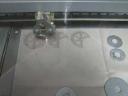
Laser Cutting Conductive Fabric

Most conductive and resistive fabrics can be easily cut with a laser.

Felting Electronics

Felting techniques illustrate how an inclinometer and rotary position sensor is constructed from conductive thread and resistive thread from Eeonyx.

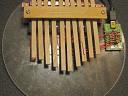
Kalimba Controller with piezo-resistive fabric pressure sensor for displacement measurement

This simple controller is inspired by the south African kalimba. The kalimba lends itself to rapid assembly because of its use of a single central bar held down by two screws to trap the array of tines between two pivot points. Wooden tines are used in this prototype because they are faster to shape than the traditional metal and this controller doesn’t require the tines to be tuned. The flexibility of copper tape is exploited as strips follow the contour of the flat base around the curve of a half-round pressure pivot.

felt capacitive proximity sensing

a qprox demo board is used to demonstrate proximity sensing with e-textiles

Orientation

Are you feeling Red, Green or Blue? Just orient this convex hexahedral cage to illumunate the color of your choice. The lights flicker when you bang the table it is on (presumably the ball in the tilt switch bounces).

Dual Multitouch Pad with pressure

This controller demonstrates how most resistive touch screen systems can be modified to provide independent sensing of two positions on the surface. A single pressure measurement is also provided with a third sensing layer. A pair of SlideWide sensors (http://infusionsystems.com) are stuck to each other at right angles.

Pressure Sensing Illuminated Button Array

Illuminated button array music controllers have a long history. I was fortunate to meet the late great, Salvatore Martirano who pioneered the construction of large button array music synthesizers.

Tablo: e-textile Fabric Drape Sensing Controller

This controller with no direct antecedents is made by draping conductive stretchable fabric over a cereal bowl creating a curve similar to the famous one called the witch [sic] of Agnesi. Resistive strips around the bowl are shorted out by the fabric and the varying resistances are measured and sent as OSC messages via USB control software on a host computer - typically resonance model sounds in Max/MSP.

The fabric is stretched in an embroidery hoop and draped over an inverted circular bowl. A piece of conductive plastic cut in a special shape forms a corolla on the surface of the bowl. The tips of each petal are folded inside the bowl and taped with conducting-adhesive copper tape or fabric tape. The microcontroller board measures the electrical resistances of these petals from their tip to a common center established with a gold-plated fabric ring at the flat of the bowl. As the conductive stretchable fabric (the “calyx” to complete the flower analogy) is displaced towards the bowl it shorts out different lengths of each conductive plastic petal.

The result is a circular array of nearly mass-less displacement sensors. The gesture-to-displacement relationship changes according to distance from the center of the bowl (variable “gearing)”. This allows for several different playing styles.

One style, similar to hand drum technique, involves tapping the fabric surface directly onto the bowl with the fingers of one hand and leaning towards the other side of the bowl with the palm. Another style involves both hands interacting from the outer hoop towards and around the base of the bowl.

You may also put it on the ground and use it as multiple foot “pedals”.

A second version increases the number of fabric pressure sensors on the base board from 2 to 16.

An important point about the Tablo is that the drape sensing allows both very delicate light touch to be sensed along with very muscular or fast gestures when the fabric touches the piezoresistive strips. It is very hard with stacked position and pressure sensors to achieve this dynamic range so essential for compelling hand drum gestures.

It has been designed so that all the important sensing nodes are surrounded by grounded fabric to keep the noise down.

The hoop is easily removed so that the only moving part (the stretch fabric) can be replaced or washed.

A single pressure sensor is snuck into the top of the bowl.

There is lots of interesting potential math behind the shape of the bowl: spherical doesn’t work well, a catenary may yield a nice linear relationship between the finger position and sensed value, the “found object” bowl used is very good and almost linear.

You can scale this design up to support multiple people playing it if you can afford the fabric.

You can also build it in a linear/keyboard style instead of "in the round".

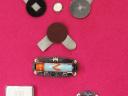
Battery and Power Supplies you can Sew

A collection of power sources for e-textile and wearables projects.

Sewn, wearable, etextile, fabric multitouch

Piezoresistive fabric is sandwiched by sewn rows of vertical and horizontal pads using a basic sewing machine's custom embroidery pattern.

Embroidered Wireless Ball Inclinometer

This wireless variant of Hannah Perner Wilson's fabric tilt sensor uses embroidereded high electrical resistance thread . I designed the tool path to create a resistive track from the patches that can be used as a potential divider . This results in a more continuous estimate of the ball location than is suggsted by the six apparently-discrete patches.