We have added support for the Sound Description Interchange
Format to the Max/MSP environment. We briefly introduce SDIF and
Max/MSP, describe how SDIF data is represented in MSP and how
to write programs to manupulate SDIF data, and demonstrate example
applications.
Max/MSP (Puckette, 1988, Zicarelli, 1998) is a real-time signal-
and event-processing environment for music. The Sound Description
Interchange Format ("SDIF") is a framework for representing
high-level sound descriptions such as sum-of-sinusoids, noise
bands, time-domain samples, and formants (Wright, et al., 1999,
Wright, et al., 1998). Many of these sound descriptions are mutable
models, affording operations such as filtering, morphing, pitch
shifting, and time stretching (Laroche, 1998). We describe the
situating of these models within an environment that provides
a variety of ways in which to do the mutating.
SDIF data consists of time-tagged frames, each containing one or more two-dimensional matrices of data such as floating-point numbers and a frame type ID indicating what kind of sound description the frame represents. For example, an SDIF frame representing additive synthesis data has a single matrix where rows represent individual sinusoids and columns represent parameters such as frequency, amplitude, and phase. A stream is a sequence of frames of the same frame type that represents a single "sonic object" evolving through time. An SDIF file may contain one stream, or multiple streams with interleaved frames. Each frame has a Stream ID, a meaningless 32-bit number that uniquely identifies the stream to which it belongs.
Unfortunately, Max/MSP's limited language of data objects does
not support SDIF s structure of matrices within frames within
streams. We circumvent this limitation with an object called SDIF-buffer that represents an SDIF
stream in memory, analogous to MSP s buffer~
object, which represents audio samples in memory. This allows
SDIF data to be represented with C data structures. Each SDIF-buffer has a symbolic name chosen
by the Max programmer.
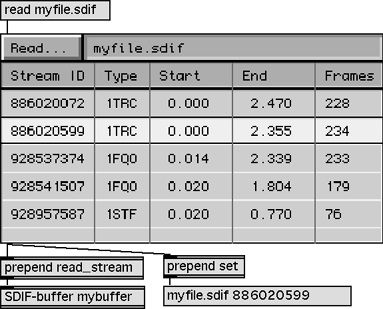
Figure 1: A graphical interface for selecting a stream from an SDIF file
One difference between SDIF and sound files is that a single SDIF
file can contain multiple sonic objects in different streams.
In our design an SDIF-buffer
holds a single SDIF stream. Therefore, to read SDIF data, the
user must specify both a file and a stream within that file. To
keep the user from having to type Stream ID numbers, we provide
a graphical tool, shown in Figure 1, that displays information
about each stream in a given file, including the type of the frames
in the stream, the total number of frames, and the times of the
first and last frames. Clicking inside this display selects a
stream; this outputs a list containing the name of the SDIF file
and the appropriate Stream ID.
MSP has objects that provide various control structures to read
data from a buffer~ and output
signals or events usable by other Max/MSP objects, and other objects
that write data to a buffer~.
By analogy, we have created "SDIF selector" objects
that select data from an SDIF-buffer
and shoehorn it into a standard Max/MSP data type, and "SDIF
mutator" objects that write new data into an SDIF-buffer.
We provide a header file that allows programmers to create new
SDIF selectors and mutators in C as Max external objects.
SDIF s resonance type consists of frequency, amplitude, decay rate, and phase for any number of resonances. This data may be interpreted as specifications for a collection of exponentially decaying sinusoids or as parameters for a parallel bank of resonant filters. (These are equivalent because the impulse response of the specified filter bank should be the same as the specified collection of decaying sinusoids.)
Two MSP externals have been written at CNMAT to perform resonance
synthesis: resonators~ implements
a parallel bank of resonant filters (Jehan, et al., 1999) and
decaying-sinusoids~ synthesizes
a collection of exponentially decaying sinusoids. Both of these
objects take their parameters as Max lists of concatenated triples
of frequency, gain, and decay rate. For example, the list "100.
.5 1. 200 .3 1.2" specifies two resonances: 100 Hertz, gain
.5, decay rate 1., and 200 Hertz, gain .3, decay rate 1.2.

Figure 2: An SDIF-controlled resonant filter bank
The SDIF selector SDIF-tuples
outputs each row of a particular matrix as a tuple containing
the desired columns. The "individual" mode outputs each
row as a separate list, while the default "concatenate"
mode concatenates all of the tuples into one large list.
Figure 2 shows an example of live sound input exciting a bank
of resonant filters. The three SDIF-buffers
holding the gong, timpani, and tubular-bell resonance models are
not shown. Clicking on any of the three message boxes first sets
the SDIF-tuples selector
to the desired SDIF-buffer,
then causes it to output a concatenated list of triplets of columns
1, 2, and 3 from the SDIF matrix. (The resonators~
object does not support control of phase, the fourth column of
the SDIF resonance matrix.) Figure 3 shows the same collection
of resonance models used as inputs to decaying-sinusoids~.
SDIF has a frame type for time-domain samples. Each column
is a channel (e.g., left and right), and each row is a sample
frame. The SDIF selector SDIF-extract-samples
copies this sample data from an SDIF-buffer
into a buffer~, making it
available for use in the rest of MSP. Optional arguments select
a subset of the channels in the SDIF stream.
SDIF has a type to represent a time-varying fundamental frequency ("F0") estimate. The rows are the different estimates and the columns are the fundamental frequency (in Hertz) and a confidence factor between 0 and 1. Obviously, there is not enough information to reconstruct an original signal from its F0 envelope, but it can be useful to "synthesize" an F0 envelope by applying it to an arbitrary synthesized timbre, as shown in Figure 4.
Since an F0 envelope changes over time, we need a control structure
for moving through the time axis of the SDIF stream. To replay
the original F0 envelope at the original speed, we start at time
zero in the SDIF stream and advance at the rate of one SDIF second
per real-time second. Of course we can advance our position in
the SDIF stream in more interesting ways for time-scale modification.
We use the term "virtual time" to mean a time position
in an SDIF stream.
In Figure 4 we use MSP s line~
object to generate a function of virtual time as it varies over
"real" time. This particular F0 trajectory is two seconds
long, so to play it at normal speed we send the list "0 0.
2000 2." to line~ so
that it will generate a signal that starts at zero and goes to
two over 2000 milliseconds. (There is an SDIF selector called
SDIF-info, that outputs information
about an SDIF-buffer such
as the times of the first and last frames; this could be used
instead of building the two second length of this particular SDIF
stream into the patch.)
By default, SDIF-tuples selects
the frame whose time tag is closest to zero, but the optional
"time" argument to the "tuples" message asks
SDIF-tuples to find the frame
closest to a given time. The snapshot~
object samples the virtual time signal every 10 ms to produce
a time value for SDIF-tuples.
The best-F0 subpatch (not
shown) selects the highest-confidence F0 estimate, which is passed
to phasor~ to generate a
sawtooth wave at that frequency. The selector~
object turns on the sawtooth wave when we start and turns it off
again when the virtual time trajectory is complete. This selector~ object could be replaced
by a ramp attenuation subpatch for click-free performance.
When we slow down virtual time enough, the frame-by-frame nature
of the SDIF data starts to become audible as frequency discontinuities.
We can avoid this problem by performing interpolation of the SDIF
data. By default, SDIF-tuples
returns data from the frame closest to the given time. The "interp"
argument causes interpolation along the time axis of the SDIF
stream. Given a desired virtual time, SDIF-tuples
finds the next earlier and next later frames in the stream, and
the ratio of the given time between the times of the two frames.
SDIF-tuples matches each
datum in the first frame with the corresponding datum in the second,
scales each by the appropriate ratio, and adds them together to
produce the result.
SDIF s sinusoidal track type contains frequencies, amplitudes, and phases for a collection of sinusoids as they evolve over time. The first column is an "index number," used to identify each sinusoid so that it can maintain its identity from frame to frame.
The easiest way to synthesize an arbitrary number of sinusoids
in Max/MSP is with CNMAT s sinusoids~
object (Jehan, et al., 1999), which takes a list of alternating
frequencies and amplitudes for a bank of sinusoids. (The sinusoids~ object does not support
control of phase.) Upon receipt of a new list, the freqency and
amplitude of each currently-sounding sinusoid is interpolated
smoothly from the current value to the new value.
Figure 5 shows additive synthesis of SDIF sinusoidal track data
with the sinusoids~ object.
When we ask SDIF-tuples to
use interpolation with sinusoidal track data, it matches the sinusoids
in each frame based on their index numbers rather than their row
positions in the matrices.
All the examples shown so far have used MSP s line~ object to create a signal containing the instantaneous virtual time. MSP s rich collection of signal processing objects can be used to create and modify these virtual time signals in interesting and musically expressive ways, for example, phasor~ could be used for looping.
We have also written an external object called time-machine~
that generates virtual time signals under real-time control. This
object is a reimplementation of the CAST time machine (Freed and
Wright, 1998) and has the same features.
Transform-based algorithms are the commonly preferred solution for convolution, pitch analysis, and additive synthesis. We use SDIF s frame type for windowed Short Time Fourier Transform results to realize a pair of spectral signal processing objects (SDIF-stft~ and SDIF-istft~) for MSP.
Each object which processes STFT data has the name of an SDIF-buffer as a first argument; it
writes its output to this SDIF-buffer
and passes the name via its outlet to subsequent objects
that will read from that SDIF-buffer.
Thus, once an incoming audio signal has been buffered and transformed,
it can be processed in the SDIF domain without needing to be re-buffered
into an MSP audio signal until it is inverse-transformed, thereby
decreasing overall latency.
The MSP signal connections between the SDIF processing objects
send a "sync" signal that has the value one when the
object s SDIF-buffer is ready
to be processed, and zero otherwise. Using a sync signal keeps
the processing of SDIF-buffers
within MSP s audio interrupt and causes MSP s signal compiler
to correctly order the execution of SDIF processing. SDIF-stft~ and SDIF-istft~
perform windowing and frame overlap, so when the overlap
rate is high they communicate new buffers more frequently.
Figure 6 shows an example of frequency-domain convolution using
the SDIF-stft~, SDIF-istft~, and SDIF-complex*~
objects.
We have started to pursue Internet streaming applications of SDIF. Early results suggest that existing streaming protocols such as the Real-time Transport Protocol ("RTP") (Schulzrinne, et al., 1996) and Real Time Streaming Protocol ("RTSP") (Schulzrinne, et al., 1998) provide an adequate framework for delivery of SDIF data, and support multicasting. As research continues towards more efficient and musically interesting streaming protocols, Max/MSP interfaces will be implemented as SDIF mutator objects that read incoming streamed data and insert it in real time into an SDIF-buffer.
Our work is focused on streaming protocols carried over TCP/IP
and UDP, the two main transport protocols used in the Internet.
We have written two Max external objects, OTUDP
and OTTCP, that use Apple
s Open Transport networking architecture to send and receive UDP
packets and TCP streams, respectively. These objects do not impose
any particular protocol on the data they transmit, so they can
be used with Open Sound Control, http, telnet, RTSP, etc.
Max/MSP can be used for graphical display of SDIF data as well as modification and synthesis.
Resonance data can be displayed using special features of the
LCD object, as illustrated elsewhere in these proceedings (Jehan,
et al., 1999). The LCD object can also be used to display F0 trajectories
and other parameters as a function of time. The LCD object can
also display time-varying data by updating its display in real
time; this is useful for spectral data such as STFT results and
frequencies and amplitudes of sinusoids.
The Open Sound Edit ("OSE") framework (Chaudhary and
Freed, 1999, Chaudhary, et al., 1998) provides 3D graphical display
and editing of SDIF data. Max can communicate with OSE by sending
OpenSound Control (Wright and Freed, 1997) messages containing
data from SDIF frames. OSE is based on OpenGL, which currently
runs on the Macintosh (Apple, 1999). Work is underway to port
OSE to the Macintosh.
Apple (1999), "Apple Ships OpenGL For Macintosh" http://www.apple.com/pr/library/1999/may/10opengl.html
A. Chaudhary and A. Freed (1999), "Visualization, Editing
and Spatialization of Timbral Resources using the OSE Framework,"
proceedings of the Audio Engineering Society 107th Convention.
A. Chaudhary, A. Freed, and L. A. Rowe (1998), "OpenSoundEdit:
An Interactive Visualization and Editing Framework for Timbral
Resources," proceedings of the International Computer Music
Conference, Ann, Arbor, Michigan.
A. Freed and M. Wright (1998), "CNMAT's Additive Synthesis
Tools," http://www.cnmat.berkeley.edu/CAST
T. Jehan, A. Freed, and R. Dudas (1999), "Musical Applications
of New Filter Extensions to Max/MSP," proceedings of the
ICMC, Beijing, China.
J. Laroche (1998), "Time and pitch scale modification of
audio signals," in Applications of Signal Processing to
Audio and Acoustics, M. Kahrs and K. Brandenburg, Eds. New
York: Kluwer Academic, pp. 279-310.
M. Puckette (1988), "The Patcher," proceedings of the
Proceeings of the 14th International Computer Music Conference,
Koln.
H. Schulzrinne, S. Casner, R. Frederick, and V. Jacobson (1996),
"RFC 1889: RTP: A Transport Protocol for Real-Time Applications"
http://www.faqs.org/rfcs/rfc1889.html
H. Schulzrinne, A. Rao, and R. Lanphier (1998), "RFC 2326:
Real Time Streaming Protocol (RTSP)" http://www.faqs.org/rfcs/rfc2326.html
M. Wright, A. Chaudhary, A. Freed, S. Khoury, and D. Wessel (1999),
"Audio Applications of the Sound Description Interchange
Format Standard," proceedings of the Audio Engineering Society
107th Convention.
M. Wright, A. Chaudhary, A. Freed, D. Wessel, X. Rodet, D. Virolle,
R. Woehrmann, and X. Serra (1998), "New Applications of the
Sound Description Interchange Format," proceedings of the
International Computer Music Conference, Ann, Arbor, Michigan.
M. Wright and A. Freed (1997), "Open Sound Control: A New
Protocol for Communicating with Sound Synthesizers," proceedings
of the International Computer Music Conference, Thessaloniki,
Hellas.
D. Zicarelli (1998), "An Extensible Real-Time Signal Processing
Environment for Max," proceedings of the International Computer
Music Conference, Ann Arbor, Michigan.