An Accessible Platform for Exploring Haptic Interactions with Co-located Capacitive and Piezoresistive Sensors
| Title | An Accessible Platform for Exploring Haptic Interactions with Co-located Capacitive and Piezoresistive Sensors |
| Publication Type | Conference Paper |
| Year of Publication | 2015 |
| Authors | Freed, Adrian, and Wessel David |
| Refereed Designation | Refereed |
| Conference Name | TEI 2015 |
| Date Published | 2015 |
| Publisher | ACM |
| Conference Location | Stanford, California |
| ISBN Number | 978-1-4503-3305-4 |
| Abstract | This paper introduces an open research platform for exploring haptic interactions with co-located, capacitive and piezoresistive sensors. The solution uses readily available material, hardware and software components and allows for experiments on many system levels from low-level material concerns up to high-level sensor fusion software. This provides the HCI community with a platform to accelerate explorations of the many applications that have opened up of sensor fusion in haptic interaction. |
| URL | https://dl.acm.org/citation.cfm?id=2680571 |
| DOI | 10.1145/2677199.2680571 |
| Full Text | INTRODUCTIONThe massification of portable touch screen devices in the last decade has precipitated a surge in investment in research and development of surface sensing techniques. One common theme has emerged in this work: the co-location of multiple sensing techniques. Many patents have been issued [17] and filed around combining capacitive and resistive sensing in particular [6] [7] [1] [16] [15]. Unfortunately, the mass manufacturing techniques used in modern, touch-screens are not readily accessible to laboratory experimenters and vernacular engineers (a.k.a. DIY, makers, bricoleurs). Also vendors are often reticent to share low-level access to their sensor streams preferring instead to wrap their innovations in high level, black-boxed Application Programmer Interfaces (API). The platform described in this paper enables many interesting explorations of the interaction potential of hybrid surface sensing without requiring exotic materials or challenging construction techniques. "Off-the-shelf" materials are used for the physical aspects and all the software required is freely available. Structure and ContributionAfter a description of the platform, some prototypes are introduced with an elaboration of some experiments associated with them. Apart from the contribution of the platform itself, this paper points to the value of using sensor fusion to leverage the temporal aspects of sensor measurements and broaden the sphere of use of tangible sensing systems. Co-located Sensor PlatformSensor ComponentsSensor components are assembled from readily available conductive materials or piezoresistive sensors from Interlink. In the first device we present, a round sensor (model number 30-81794) is switched between resistive and capacitive modes. For the second device, the interdigitated conductors of a square FSR (30-73528) were separated from the piezoresistive backing material and stacked onto a piezoresistive track pad (54-00031). These configurations correspond to the two major design patterns seen in the literature and prior art: 1) shared, switched components and 2) stacked layers with fixed-function capacitive and resistive sensing. Microcontrollor Data AcquisitionThe Freescale MK20DX256 microcontroller was chosen for this work because it includes dedicated capacitance measurement hardware, two 16-bit ADC's, and it provides a dozen I/O pins that can be dynamically switched among many functions: digital output, digital input, input with pull-up resistors, analog voltage input and capacitance sensing. This microcontroller is available in a compact board (Teensy 3.1) for which a free, multi-platform software development environment is available (Arduino and Teensyduino). Sensor Fusion and Signal ConditioningThe platform includes: · A Freescale 96MHz ARM 32-bit microcontroller that can perform sensor fusion computations and run gesture analysis and estimation algorithms. For development purposes, it is mostly used for data acquisition, time stamping and to transmit the measurands to a more powerful host computer via USB or Ethernet. · The o.io component [3] of the odot system running on the host computer in the freely-available PD or commercially-supported Max/MSP/Jitter programming environments. This is used to display, process and map the sensor data. Mappings to sound facilitate experiments on the temporal aspects of gesture leveraging the particular capabilities of the human auditory system. · The expression language of the “odot” system [4] provides arithmetic operations on high resolution time stamps allowing, for example, the computation of velocity estimates of touch and motion parameter vectors. Case StudiesSwitched ModalityThis example employs a single sensing system and rapidly switches between resistive and capacitive measurement modes.
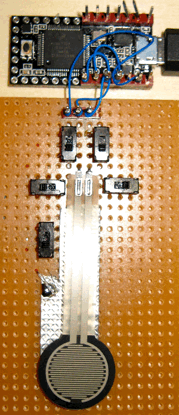
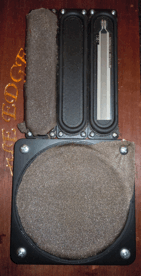
Figure 1. Microcontroller, Fault-simulating Switches and FSR. The round Force Sensing Resistor (FSR) at the bottom of Figure 1 is made from an interdigitated array of printed silver ink conductors separated from a semiconducting, piezoresistive substrate by an air gap. Displacement (from the press of a finger) brings the conductive and semiconducting substrates into contact. These FSR’s thereby combine a switching action and a compression-sensing action. Other researchers and suppliers use this common design pattern. The separating function has been implemented in various devices by exploiting the mechanical properties of the plastic layers involved, using trapped air [10], sparse arrays of elastomeric dots [2] or porous fabric nets [11]. While the conductive elements are separated from the resistive material, they can be used as plates for capacitive sensing. One of the interdigitated conductors is grounded. The other is connected to two different input pins of the Teensy microcontroller board. One of those pins is switched between capacitive and voltage measurement modes; the other provides a "pull-up" resistor to the 3.3v supply rail that is only enabled during voltage measurements. This provides the current source needed to estimate electrical resistance values from the measured input voltages. Switching between sense modalities is determined by the actual values obtained in each mode: sudden large increases in measured capacitance signal the closures of the switching action of the sensor. This precipitates the transition to resistive measurements. Jumps to high voltage values, measured during resistive mode, signal the separations from the resistive material, prompting a return to capacitive measurements. The simple prototype of Figure 1 was developed to learn whether capacitance sensing could serve as a degraded-performance backup of a resistive sensor system subject to wear and failures [8]. The dark slide switches allow simulation of broken leads to the sensor, shorts to ground and shorts between the leads. We have confirmed that a finger press on the sensor can be detected in all the fault scenarios except (as we expected) for the case of both leads shorted to ground or both leads broken. We were, in those cases, able to establish and report the nature of the fault. We learned from this prototype that the proximity of the resistive surface to the conductors produces a significant shunt capacitance that shapes the e-field and reduces sensitivity of the capacitive sensing to a usable range of 4mm from finger to surface. Stacking a special-purpose sensor on top of a resistive sensor allows for a reduction of capacitive coupling and increased sensitivity and dynamic range for proximity estimation. This is explored in the following section. Stacked Concurrent SensorsThe sensor system of Figure 2 includes a piezoresistive track pad that senses position and pressure of a single finger touch or stylus point. It has a thick protective upper layer to resist wear from pens in “point of sale” applications. The interdigitated conductors glued on top were taken from a square FSR from Interlink. Its original resistive layer was peeled off and put aside leaving just the conductors that are used primarily as a proximity sensor, complementing the position and pressure sensing of the track pad underneath. |

| Attachment | Size |
|---|---|
| ColocatedSensorsTEI2015optim.pdf | 394.59 KB |